how do you draw particle markers in syntax trees
Linguistics 522
Lecture 3
Phrase-markers
Structure-dependence is the theme of our course. We have been arguing for it in terms of the trees we draw for sentences, which capture information of two kinds:
- Syntactic categories
- Syntactic structure (phrases)
First phrasehood.
- The boy must seem incredibly stupid to that girl.
- [The boy] must [seem [incredibly stupid] [ to [that girl]]].
Second, categoriality.
- tree on p. 53, (3)
The trees we'll be using then embody two notions, constituency (phrasehood) and categoriality. Radford doesn't call these structures trees. He calls them phrase-markers. The term tree is actually more popular among linguists and computer scientists alike. But is isn't more popular with one very important guy, Noam Chomsky. For some reason never made particularly clear to me, Noam Chomsky never talks about trees. He always talks about phrase markers.
Radford follows Chomsky here.
Defining basic Terms
graph, node, root node: Whether you say tree or phrase-marker, the structure can be formally thought of as a graph, a mathematical term that's particularly important in computer science. A graph is just any structure with points and lines between them, and a tree is just a special kind of graph with a fussier definition. The points in a graph are also called nodes and that is the term linguists use for the points in a phrase markers or a tree. Some of the nodes in tree (1) on p. 110 are the S-node (called the root node, because it's the top), the VP node, the NP node and the P node.
immediately dominates, dominates, exhaustively dominates, mother, daughter, sister, precedes, immediately precedes
| (1) |
mother, daughter, sister: used to describe nodes in an immediate dominance relation. A node M is the mother of a node D, if and only if M immediately dominates D. In the same situation we say D is a daughter of M. That is, a node D is the daughter of a node M if and only if M immediately dominates D. Two nodes that have the same mother are sisters. In tree (1), NP1 is the mother of D, V exhaustively dominates: A node M exhaustively dominates a set of nodes D1 through Dn if and only if M is the mother of each D' and there are no other nodes M is the mother of. In other words, the set of nodes a mother dominates must include all her daughters. In tree tree (1) on the left, TP does not exhaustively dominate NP and VP. It exhaustively dominates NP, T, and VP. dominates: Dominates is defined as follows:
precedes: Precedes is defined as follows:
Note that dominance and precedence are mutually exclusive. A node X cannot both dominate and precede another node Y. Essentially what this terminology does is break phrasehood down into two parts, dominance and precedence. A phrase is series of elements (words or phrases), dominated by a single node, which come in a fixed order. |
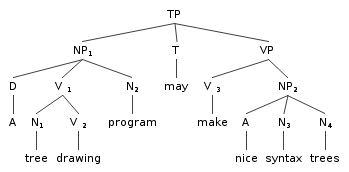
Constituent, constituent of, immediate constituent of:
- A set of nodes form a constituent of some sentence structure if and only if they are exhaustively dominated by a single node in that structure.
- A node A is a constituent of of some other node B if and only if B dominates A.
- A node A is an immediate constituent of of some other node B if and only if B immediately dominates A.
The following table summarizes these points:
| (2) 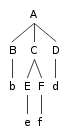 |
Observation We now have four ways of expressing the relation between nodes that is exemplified in tree (2):
- A immediately dominates C.
- A is the mother of C.
- C is a daughter of A.
- C is an immediate constituent of A.
Defining traditional grammatical terms, pp. 112, 113
Not important at this stageC-Command
We've talked about mothers, grandmothers, great grandmothers, and so on, which I'll write great ... grand mothers. Now it's time to talk about nieces and great ... nieces.
Branching node:
- A node is branching if and only if there are at least two nodes in the set of nodes it exhaustively dominates.
C-Command:
- X C-commands Y if and only if the lowest branching node dominating X also dominates Y and X does NOT dominate Y nor does Y dominate X.
Consider the following example:
| (3) | B C-Commands C, D, E, F, and G. C C-commands B [so C and B C-command each other.] C does NOT C-command D,E,F,G, because it dominates all of them. |
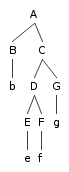
Here is where the nieces and great ... nieces come in:
- A node C-commands its sisters and its nieces and its great .... nieces, that is the daughters and grandaughters and great- .... granddaughters of its sisters. Note that sisters C-command each other.
Anaphora and C-command
Reflexives and reciprocals are special forms that occur only in special syntactic contexts:
- John shaves himself often.
- John and Mary like each other.
The claim made in the text is reflexives and reciprocals are dependent in a special way. Like pronouns they require antecedents. Unlike pronouns they require those antecedents to be in a special syntactic configuration:
- Mary liked him.
- * Mary liked himself.
- John's mother likes him.
- * John's mother likes himself.
- His mother likes John.
- * Himself's mother likes John.
- * Himself likes John.
- Mary and Sue liked each other.
- * Mary and Sue's mother likes each other.
- * Each other likes Mary and Sue.
Words like reflexives and reciprocals that have this special dependency property are called anaphors. The following proposal is made for anaphors:
- Principle A
- C-Command condition on anaphors.
- An anaphor must have an antecedent that both precedes and C-commands it.
- * Mary liked himself.
- * John's mother likes himself.
The following example shows that C-command alone is not anough:
- * We gave pictures of each other to John and Mary.
The account also accounts for the ambiguity of examples like this
- We shot arrows at each other.
Questions to Think About
Now think about the following example:
- Sarah and Sue talked to Mark and Hubert about each other.
Now think about this one:
- Mary and Sue thought those pictures of each other were great.
- Mary and Sue's pictures of each other were flattering.
And finally:
- Those pictures of themselves pleased Mary and Sue.
Phrase-Structure rules and lexicon
We now move to a more precise statement of what the grammar looks like.
We need a finite set of rules that can "generate" an infinite set of sentences.
We're going to have two kinds of "rules"
- Phrase-structure rules, which are used to "admit" or "license" phrase-marers (trees) and look like this:
- TP -> NP T VP
- Lexical entries, which for the moment, just assign categories to words. They look like this:
- boy, N
The lexical entry for "boy" says "boy" is a noun. We'll call the categories that belong to some lexical entry lexical categories.
We call the nodes in a tree that dominate words or nothing terminal nodes. Consider the following partial tree:
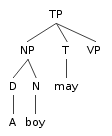
Phrase structure-rules and phrase markers
A phrase-structure rule admits local trees:
- S -> NP M VP
- All the local trees are admitted by phrase-structure rules in G.
- All the terminal nodes dominate words of the appropriate lexical category as defined by the lexicon of G.
Definition of grammaticality
We call the words admitted by some well-formed tree the yield of that tree.
Now we can say what strings are generated by a grammar G.
A string is grammatical if and only if it it is the yield of some tree admitted by the grammar.
Determining when a sentence is grammatical accoding to a grammar
Our job in this course is not so much to find the right grammar of English as to find ways of evaluating candiadtre grammars. As a result, the most important skill you learn in this course will be determining whether or not some proposed grammar characterizes an example sentence as grammatical.
If the grammar says the sentence is grammatical and our intuitions tell us it's grammatical, good for the grammar.
If the grammar says the the sentence is grammatical and our intuitions tell us it's ungrammatical, we say the grammar overgenerates.
If the grammar says the the sentence is ungrammatical and our intuitions tell us it's grammatical, we say the grammar undergenerates.
It's pretty safe to safe all the grammars we consider in this course will do both. It will undergenerate because there are lots of constructions we won't consider. For example:
- John grew happier, the more he ate.
Our rules will overgenerate because even for the constructions we DO consider there are all kinds of constraints we are ignoring. For example:
- NP -> D N
- a book
- all men
- * a books
- * all man
The skill we need for this course is to be able to take a set of rules and a set of data and decide whether the rules account for the data. If not, we need to be able to decide on the simplest change to our rules that will extend them to cover the data.
Execrcise V, p. 160 is about this.
Particles and conjunctions
The question raised is whether we need to recognize new lexical categories for particles and conjunctions.Particles first:
- He put on his hat.
- If you pull too hard, the handle will come off.
- He was leaning too far out over the side and fell out.
- He went up to see the manager.
- He put his hat on his head.
- If you pull too hard, the handle will come off the door.
- He was leaning too far out over the side and fell out the window.
- He went up the stairs to see the manager.
- After he ate he fell asleep.
- After the meal, he fell asleep.
- Matilda was envied for being such a good syntactician.
- Matilda was envied for her talent.
- I should wait until you return.
- I should wait until your return.
- There has been no trouble since you left.
- There has been no trouble since your departure.
And sometimes a single word can be a preposition, a particle, and a conjunction:
- There has been no trouble since.
- There has been no trouble since your departure.
- There has been no trouble since you left.
So what Radford argues for (Emonds's analysis) is that there are three uses of prepositions, the canonical preposition use (where they take an NP complement), the conjunction use (they take a clause complement) and the particle use (they take no complement). This is just the kind of variation we see with verbs.
- John knows.
- John knows the answer.
- John knows that Columbus landed in the West Indies.
- John went out.
- John went out the door.
- * John went out Mary exited.
- John ate.
- John ate the apple.
- * John ate Mary ate.
Another argument, essentially a distributional argument, is that prepopositions, conjunctions, and particles may all take the same modifiers:
- John left immediately before the party started.
- John left immediately before that.
- John left immediately before.
Now what about restrictions on all this behavior?
Many prepositions cannot be used as particles:
- * He left until.
- * He left during.
- He left while the party.
But Emonds's story is going to be that these restrictions are not categorial. They are lexical restrictions. That is, these differences among what Emonds call prepositions are like the differenvces between ordinary verbs. Some verbs take S- but not NP-complements:
- John hopes Mary will arrive soon.
- * John hopes Mary's arrival.
- * John enjoyed that Mary danced.
- John enjoyed Mary's dance.
- John fell.
- * John fell the stairs.
Notice all the argumentation is about parsimony here. Let's have fewer lexical categoires, because overall that gives us a simpler picture of grammar.
Why is simpler better? Well if we constrain the class of grammars (by constraining the class of categories they can use), then maybe we are on the way to explaining why children learn them so easily.
We'll see.
Conflating categories
Continuing along the same lines. Now we try to constrain the class of categories by collapsing several categories together.First we try to collapse adjectives and adverbs.
Arguments:
- Morphological: Both adjectives and adverbs have comparative and superlative forms
- Objection: Many adverbs form their comparative and superlative forms not with -er and -est but with more and most.
- Response: So do many adjectives like expensive and probable.
- Often the same comparative form will be shared by an adjective and its -ly counterpoart.
- She was happier than he was.
- * She works happilier than he does.
- She works happier than he does.
- Syntactic: Adjectives and Adverbs have similar premodifiers like very, really, and extremely.
New official treatment: Adj and Adv get collapsed. We call the new category A (rather than advective or adjerb).
Questions to Think about
Now think of an objection to collapsing adverbs and adjectives. What's the first problem that comes to mind?
Not conflating categories
The argument for conflating Adj and Adv was really based on something you may have learned about in previous linguistics classes called complementary distribution. The idea is basically the Superman/ Clark Kent idea. If there are two entities you never see in the same place at the same time, then maybe underlyingly they're the same entity. It's just that sometimes they're wearing glasses. So the idea was that adverbs are just adjectives wearing glasses.
In this particular case, the idea was that there's one category which "surfaces" as an adjective when it's modifying a Noun, and as an Adverb everywhere else.
Compare this to the treatment of allomorphy in the case of plural s
- fox: /f aa k s/ + /ax z/
- dog: /d ao g/ + /z/
- duck: /d uh k/ + /s/
Why not do more of the same?
Why not collapse adjectives and determiners? There are a variety of facts that argue against this.
The basic morphological argument is that there is no shared morphology between determiners and adjectives:
- Adjectives have comparative and superlative forms; determiners do not
- Adjectives take -ly to become Adverbs; determiners do not
- Adjectives take -ness to become noun; determiners do not.
- And so on...
Distributional arguments:
- Different distributions. Determiner must always precede adjective in an NP:
- The red book
- * Red the book
- Adjectives can iterate or "stack up" to the left of a noun; determiners can not
- * a the book
- the big green machine
- More important (in my book). Adding a determiner can an NP "complete". Adding an Adjective cannot:
- * book
- a book
- * favorite book
- my favorite book
- Determiners and Determiners can be conjoined; adjectives and adjectives can be conjoined; determiners and adjectives cannot.
- each and every way
- a lazy and inconsiderate man
- *each and lazy man
Semantic arguments.
- Selection between Adjectives and Nouns on semantic grounds
- Selection between
Sample exercise answers
Excercise VI. Example answers.
- a: central determiner
- a few books: CENDET + POSTDET
- an additional book: CENDET + POSTDET
- half a book: PREDET + CENDET
- * a the book: * CENDET + CENDET
- no two books: CENDET + POSTDET
no additional book: CENDET + POSTDET
* no the book: * CENDET + CENDET
problem: *all no book: PREDET + CENDET
weatherspoonwithaske.blogspot.com
Source: https://gawron.sdsu.edu/syntax/course_core/lectures/lec3.htm
0 Response to "how do you draw particle markers in syntax trees"
Postar um comentário